
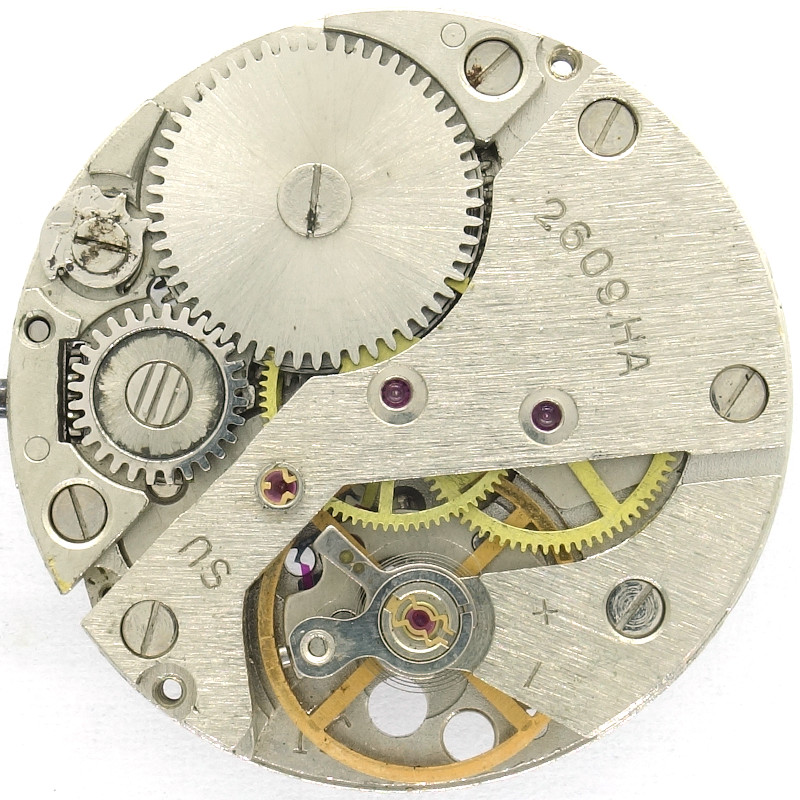
Anyone who wants to truly understand watches must first understand the movement. Case shapes — round, square, or tonneau — and functions ranging from simple three-hand displays to perpetual calendars are merely the “skin.” The movement is the heart that makes everything possible.
When people ask how to quickly become knowledgeable about watches, the first advice is to learn the brands. The second — and more important — is to study what movement is inside the watch.

An interesting fact: a mid-range Swiss three-hand watch may use the very same base movement as a high-end chronograph, moonphase, or even perpetual calendar. The difference lies in how the higher-end brand modifies the base caliber — adding modules, altering components, and refining finishing.
A base movement typically offers simple or single functions. It can be installed directly into a case for a straightforward watch, or it can serve as a flexible platform for additional complications and creative layouts.
In fact, as early as two or three centuries ago, during the pocket watch era, watchmakers were already producing variations based on the same basic architecture but with different functional executions.
After World War II, as watchmaking became increasingly industrialized, fewer brands were able to manufacture complete movements independently. Many turned to specialized movement manufacturers, purchasing finished base movements and modifying them before casing.
Without base movement suppliers, most Swiss and German brands would struggle to produce watches at all.
The Swatch Group, especially its subsidiary ETA, has long supplied the majority of Swiss brands with movements and components. Although ETA has repeatedly announced plans to limit external supply, commercial reality has kept its calibers widely available.
Two of the most commonly used movements are the ETA 2892 and ETA 7750. Even prestigious brands have used them as foundations for entry-level models.
As case sizes increased over the years, larger pocket-watch-style movements regained popularity. The improved ETA 6497/6498, relaunched in 1994, has become a favorite for oversized watches. While not ultra-luxury in origin, watches built around it are rarely inexpensive.
For higher-tier brands, rarer calibers symbolize prestige.
Many brands proudly advertise “in-house movements.” However, aside from giants like Rolex or Patek Philippe, in-house does not automatically guarantee superior performance. Often, such watches are priced significantly higher, while actual functional advantages may be marginal.
For watch enthusiasts, understanding these nuances becomes a way to demonstrate true knowledge. What may begin as casual curiosity can, over time, develop into genuine expertise.
 English
 Español
 Русский язык
 Français
 بالعربية
 Facebook
 Youtube
 Linkedin
 Twitter
 Instagram
 Pinterest